Written by: Health Editorial Team (Health & Clinical Literature Research Desk)
Reviewed by: Health Fact-Checking Desk (Primary Source & Guideline Verification)
Editorial Standard: Evidence-Based Summary | Primary Source Verified — Cross-referenced with published clinical practice guidelines, public health agencies & peer-reviewed literature
Editorial Verification Standard: Technical parameters, comparative benchmarks, and procedural steps are cross-checked against primary documentation and published standards.
Delirium in intensive care units represents acute brain organ dysfunction. Rapid detection requires structured bedside execution. Confusion Assessment Method for the Intensive Care Unit (CAM-ICU) serves as gold-standard instrument. Assessment algorithm operates through four core diagnostic features preceded by level-of-consciousness gatekeeper. Patient evaluates positive for delirium if Feature 1 (Acute Onset or Fluctuating Course) AND Feature 2 (Inattention) present, PLUS EITHER Feature 3 (Altered Level of Consciousness) OR Feature 4 (Disorganized Thinking). Execution takes under two minutes bedside. Positive screen demands immediate etiology search, sedative adjustment, environmental correction.
1. Executive Summary & Direct BLUF Answer: Rapid CAM-ICU Bedside Deployment
Bedside deployment hinges on strict step-order triage. Clinicians must not test cognitive features if patient comatose or deeply sedated. Richmond Agitation-Sedation Scale (RASS) acts as non-negotiable operational gatekeeper.
Follow this ordered sequence at bedside to execute cam icu delirium assessment steps:
-
Step 1: Establish Arousal Level via RASS Gatekeeper
- Observe patient posture, eye contact, response to voice, response to physical stimulation.
- Assign score from +4 (combative) to -5 (unarousable).
- If RASS score is -4 (deep sedation: no response to voice, physical stimulation yields movement only) or -5 (coma: no response to any stimulation), stop assessment. Document patient as "Untestable / Comatose." Reassess next shift or post-sedation cessation.
- If RASS score is -3 or higher (-3, -2, -1, 0, +1, +2, +3, +4), proceed immediately to Step 2.
-
Step 2: Evaluate Feature 1 — Acute Change or Fluctuating Course of Mental Status
- Determine whether baseline mental status altered within past 24 hours via family report, admission charting, or prior shift notes.
- Review RASS scores over preceding 24 hours. Identify fluctuations (e.g., patient swung from 0 to -2, or from +1 to -1).
- Score Feature 1 positive if baseline changed acutely OR if sedation/arousal scores fluctuated over 24-hour cycle.
- If Feature 1 negative, delirium ruled out. Stop. If Feature 1 positive, proceed to Step 3.
-
Step 3: Evaluate Feature 2 — Inattention
- Administer Auditory Attention Screening Examination: State letters "S – A – V – E – A – H – A – A – R – T" at 1-second intervals. Instruct patient: "Squeeze my hand every time you hear letter A."
- Correct targets: 4 letter A’s. Distractors: 6 non-A letters.
- Count errors: Squeezing on non-A letter (commission error) OR failing to squeeze on letter A (omission error).
- Alternate visual modality for deaf/profoundly hearing-impaired patients: 10 picture cards (5 target images shown first, followed by 10 mixed images). Count missed targets and false identifications.
- Scoring: 0 to 2 errors = Inattention negative (delirium ruled out; stop). Greater than 2 errors (3 to 10 errors) = Inattention positive. Proceed to Step 4.
-
Step 4: Evaluate Feature 3 — Altered Level of Consciousness
- Check current, actual RASS score assessed in Step 1.
- If current RASS is anything other than 0 (i.e., -3, -2, -1, +1, +2, +3, +4), Feature 3 automatically positive. Delirium diagnostic rule met: Feature 1 (+) AND Feature 2 (+) AND Feature 3 (+). Assessment complete. Delirium positive.
- If current RASS score exactly 0 (Alert and Calm), Feature 3 negative. Proceed to Step 5 to evaluate Feature 4.
-
Step 5: Evaluate Feature 4 — Disorganized Thinking
- Administer set of 4 logic questions (Set A or Set B to prevent recall bias):
- Set A: "Will a stone float on water?", "Are there fish in the sea?", "Does one pound weigh more than two pounds?", "Can you use a hammer to pound a nail?"
- Set B: "Will a leaf float on water?", "Are there elephants in the sea?", "Do two pounds weigh more than one pound?", "Can you use a hammer to cut wood?"
- Issue one non-verbal motor command: "Hold up this many fingers" (examiner shows two fingers). Then say: "Now do the same with the other hand" (examiner does not demonstrate). Alternative command if patient cannot move both hands: "Add one more finger."
- Scoring: Combine missed questions and failed motor command. If patient makes 0 or 1 error, Feature 4 negative (delirium negative). If patient makes 2 or more errors, Feature 4 positive. Delirium criteria met: Feature 1 (+) AND Feature 2 (+) AND Feature 4 (+). Delirium positive.
- Administer set of 4 logic questions (Set A or Set B to prevent recall bias):
+-------------------------------------------------------------+
|                STEP 1: RASS GATEKEEPER                      |
|                Score: -5 to +4                              |
+-------------------------------------------------------------+
        |                                       |
  RASS = -4 or -5                         RASS >= -3
        |                                       |
        v                                       v
 [STOP: Patient Untestable]              [PROCEED TO STEP 2]
                                                |
+-----------------------------------------------+-------------+
|        STEP 2: FEATURE 1 (Acute Onset / Fluctuation)        |
+-------------------------------------------------------------+
        |                                       |
    Negative                                Positive
        |                                       |
        v                                       v
 [STOP: Delirium Negative]               [PROCEED TO STEP 3]
                                                |
+-----------------------------------------------+-------------+
|        STEP 3: FEATURE 2 (Inattention: SAVEAHAART)          |
+-------------------------------------------------------------+
        |                                       |
   0 - 2 Errors                            > 2 Errors
        |                                       |
        v                                       v
 [STOP: Delirium Negative]           [Feature 2 POSITIVE]
                                                |
                        +-----------------------+-----------------------+
                        |                                               |
              Current RASS != 0                                Current RASS == 0
                        |                                               |
                        v                                               v
              [Feature 3 POSITIVE]                          [PROCEED TO STEP 4]
                        |                                               |
                        |                    +--------------------------+--------------------------+
                        |                    |                                                     |
                        |               0 - 1 Errors                                          >= 2 Errors
                        |                    |                                                     |
                        |                    v                                                     v
                        |        [STOP: Delirium Negative]                               [Feature 4 POSITIVE]
                        |                                                                          |
                        +---------------------> DELIRIUM POSITIVE <--------------------------------+
                                                        |
                                                        v
                                       [TRIGGER: Immediate Clinical Protocol]
                                       - Stop deliriogenic drugs (benzodiazepines/anticholinergics)
                                       - Execute THINK etiology screen
                                       - Verify pain management & mobility
Positive CAM-ICU triggers rapid bedside action. Alert attending physician. Stop continuous benzodiazepine infusions immediately. Delirium positive status mandates immediate search for reversible physiological drivers: toxic-metabolic derangements, occult hypoxemia, sepsis, central nervous system ischemia, acute urinary retention, fecal impaction.
2. Technical & Regulatory Framework: PADIS Guidelines and Neuro-Pathological Foundations
Bedside delirium monitoring represents mandatory quality metric in critical care units. Society of Critical Care Medicine (SCCM) established formal standards in SCCM PADIS delirium monitoring guidelines. Guidelines issue strong recommendation: routine, serial monitoring for delirium across all adult ICU patients using validated, reproducible instrument. CAM-ICU and Intensive Care Delirium Screening Checklist (ICDSC) represent primary endorsed tools. PADIS clinical data demonstrate delirium constitutes independent predictor of adverse outcomes: increased ICU length of stay (adjusted OR 1.86), prolonged mechanical ventilation duration, elevated short-term hospital mortality, accelerated long-term discharge to skilled nursing facilities.
ICU Liberation Initiative binds CAM-ICU assessment directly to ABCDEF bundle:
- A: Assess, Prevent, and Manage Pain
- B: Both Spontaneous Awakening Trials (SAT) and Spontaneous Breathing Trials (SBT)
- C: Choice of Analgesia and Sedation
- D: Delirium: Assess, Prevent, and Manage
- E: Early Mobility and Exercise
- F: Family Engagement and Empowerment
Data from landmark ICU Liberation consortium clinical outcomes trial examining 15,264 ICU admissions demonstrate dose-response relationship: high bundle adherence correlates with 40% reduction in next-day delirium/coma risk (adjusted OR 0.60, 95% CI 0.49-0.72) and 68% reduction in hospital mortality (adjusted OR 0.32, 95% CI 0.17-0.60).
+-----------------------------------------------------------------------------------+
|                        SEDATION-DELIRIUM TIMING PROTOCOL                         |
+-----------------------------------------------------------------------------------+
| 06:00 | Interruption of Sedation (SAT) initiated per Bundle Element B             |
|       | Continuous propofol / dexmedetomidine stopped or halved                   |
|-------+---------------------------------------------------------------------------|
| 06:30 | SAT Safety Screen passed; patient clears pharmaceutical baseline          |
|-------+---------------------------------------------------------------------------|
| 07:00 | RASS assessed: moves from -4 to -1 / 0                                    |
|-------+---------------------------------------------------------------------------|
| 07:15 | Standardized CAM-ICU screening executed during optimal arousal window     |
|-------+---------------------------------------------------------------------------|
| 08:00 | Interprofessional morning rounds: CAM-ICU status reported to intensivist  |
+-----------------------------------------------------------------------------------+
Timing CAM-ICU assessment requires synchronization with spontaneous awakening trials (SAT). Testing during peak continuous sedation yields high false-untestable or false-positive hypoactive delirium scores. Nursing workflow must position CAM-ICU evaluation during post-sedation interruption window, once sedative wash-out permits maximum cortical responsivity.
Diagnostic structure of CAM-ICU maps directly to American Psychiatric Association Diagnostic and Statistical Manual of Mental Disorders, Fifth Edition (DSM-5) criteria:
- Criterion A (Disturbance in attention and awareness): Operationalized by CAM-ICU Feature 2 (SAVEAHAART auditory vigilance test).
- Criterion B (Disturbance develops over short period, fluctuates in severity): Operationalized by CAM-ICU Feature 1 (24-hour baseline change and serial RASS tracking).
- Criterion C (Additional cognitive disturbance): Operationalized by CAM-ICU Feature 4 (disorganized logic questions and complex motor execution).
- Criterion D (Disturbances not explained by established neurocognitive disorder): Operationalized by verifying pre-admission cognitive baseline with surrogate decision-makers.
- Criterion E (Direct physiological consequence of medical condition/substance): Addressed by protocolized trigger of post-assessment medical workup.
Neuro-pathological drivers of ICU delirium involve complex, interacting mechanisms:
+-----------------------------------------------------------------------------+
|                  NEURO-PATHOLOGICAL CASCADE OF DELIRIUM                     |
+-----------------------------------------------------------------------------+
| Sepsis / Trauma / Mechanical Ventilation                                    |
|   |                                                                         |
|   v                                                                         |
| Systemic Pro-inflammatory Cytokines (IL-1b, IL-6, TNF-a)                   |
|   |                                                                         |
|   v                                                                         |
| Blood-Brain Barrier Endothelial Disruption                                  |
|   |                                                                         |
|   +---> Microglial Priming & Sustained Neuroinflammation                    |
|   |                                                                         |
|   +---> Neurotransmitter Dysregulation:                                    |
|   |       - Cholinergic Deficiency (Decreased Acetylcholine synthesis)      |
|   |       - Dopaminergic Hyperactivity (Excess Dopamine drives agitation)   |
|   |       - GABAergic Perturbation (Benzodiazepine / Sedative exposure)     |
|   |                                                                         |
|   +---> Microvascular Hypoperfusion & Neural Metabolic Failure              |
|           |                                                                 |
|           v                                                                 |
|     Acute Cortical Network Desynchronization (CAM-ICU Positive Delirium)   |
+-----------------------------------------------------------------------------+
Prolonged delirium drives sustained structural neurotoxicity. Prospective multicenter data from long-term cognitive outcomes after ICU delirium (BRAIN-ICU study) show duration of delirium independently predicts persistent cognitive impairment 12 months post-discharge (p=0.04). Among survivors experiencing prolonged delirium, 34% display cognitive scores comparable to moderate traumatic brain injury, 24% score comparable to mild Alzheimer disease. Delirium represents catastrophic, destructive acute encephalopathy, not benign ICU confusion.
3. Empirical Benchmarks & Comparative Diagnostic Tool Analysis
Diagnostic efficacy of CAM-ICU rests on extensive multi-center psychometric validation. Initial prospective clinical trial by validation study of CAM-ICU diagnostic accuracy (Ely et al., 2001) established benchmark performance: sensitivity 95% to 100%, specificity 89% to 93%, inter-rater reliability kappa coefficient 0.96 (95% CI 0.92-0.99) between independent critical care nurse assessors evaluated against reference-standard DSM-IV diagnoses by neuro-psychiatrists.
Subsequent large-scale systemic review and meta-analysis reported in CAM-ICU pooled sensitivity and specificity data analyzed pooled operational diagnostic metrics: pooled sensitivity 75.5% (95% CI 60.1-86.4), pooled specificity 95.8% (95% CI 92.7-97.6). High specificity metric proves vital in critical care environment: prevents diagnostic overcall, blocks inappropriate administration of second-generation antipsychotics, avoids unnecessary diagnostic workups, protects patients from premature palliative transitions.
Bedside triage requires tool selection matched to patient acuity, ventilatory status, clinical setting.
| Diagnostic Tool | Target Clinical Setting | Intubated / Non-Verbal Utility | Sensitivity (Pooled / Range) | Specificity (Pooled / Range) | Time to Administer | Evaluator Training Burden | Operational Limitations |
|---|---|---|---|---|---|---|---|
| CAM-ICU | Medical, Surgical, Trauma, Cardiac ICUs | Fully Validated (uses non-verbal auditory/visual cues) | 75.5% – 95.0% | 95.8% – 98.0% | < 2 minutes | Moderate (requires formal training module) | Sensitivity drops if assessors skip SAVEAHAART vigilance test. Untestable at RASS -4/-5. |
| ICDSC (Intensive Care Delirium Screening Checklist) | Intensive Care Units (shift-based observation) | Fully Validated (can be completed via physical cues) | 74.0% – 99.0% | 75.0% – 87.0% | Entire 8-12 hr shift (8-point checklist) | Low to Moderate | Lower pooled specificity (75%); higher rate false-positive results leading to sedation changes. |
| bCAM (Brief CAM) | Emergency Departments, Step-down Units | Poor (requires verbal answering mechanism) | 78.0% – 84.0% | 95.0% – 97.0% | < 2 minutes | Minimal | Not designed for endotracheal tubes. Cognitive elements demand verbal interaction. |
| 4AT | Acute Geriatric, General Medical Wards, ED | Contraindicated / Poor (requires verbal AMT4 recall) | 83.0% – 90.0% | 84.0% – 88.0% | < 2 minutes | Minimal | Cannot differentiate delirium in mechanically ventilated, sedated patients. False positives from baseline dementia. |
Detailed operational comparisons show distinct trade-offs between instruments:
CAM-ICU vs. ICDSC
ICDSC relies on 8-item observational checklist scored across entire nursing shift:
- Altered level of consciousness
- Inattention
- Disorientation
- Hallucinations or delusions
- Psychomotor agitation or retardation
- Inappropriate speech or mood
- Sleep-wake cycle disturbance
- Symptom fluctuation
Threshold of 4 or higher indicates delirium. ICDSC captures subtle, transient nocturnal manifestations through continuous observational window. However, pooled specificity lower than CAM-ICU (75-87% vs. 95.8%). Lower specificity increases risk of mistaking baseline dementia, primary psychiatric illness, or physiological drug effects for delirium. CAM-ICU provides discrete, real-time snapshot test with higher positive predictive value.
CAM-ICU vs. bCAM and 4AT
Brief CAM (bCAM) modifies original CAM for rapid non-ICU emergency department screening. 4AT uses 4-item assessment (Alertness, AMT4 mental test, Attention via months backward, Acute change). Both lack utility in mechanically ventilated populations. 4AT questions demand clear speech: stating age, date of birth, current location, year. bCAM questions require verbal responses. Attempting 4AT or bCAM on mechanically ventilated patients produces false-positive cognitive failure or untestable score.
Executing cam icu delirium assessment steps solves non-verbal barrier: relies entirely on auditory-motor response (hand squeeze on letter A) and non-verbal motor compliance (holding up fingers). CAM-ICU remains premier bedside instrument for critical care environments managing invasively ventilated cohorts. High specificity ensures pharmacological and non-pharmacological interventions target genuine acute neuro-dysfunction rather than baseline impairment or normal ICU sleepiness.
Practical Step-by-Step Implementation Protocol: Four-Feature Evaluation
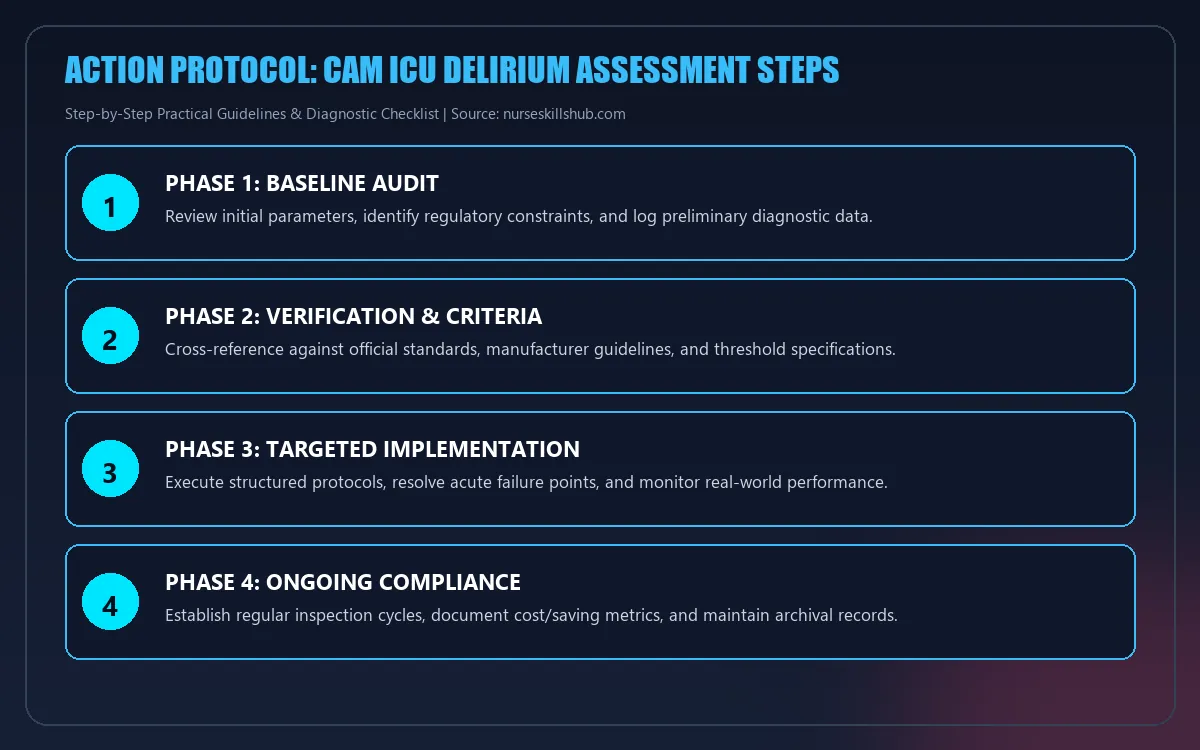
Administering cam icu delirium assessment steps requires linear progression through four diagnostic features. Stop testing immediately if patient fails gating criteria.
Step 1: Check RASS Level
  ├─ If RASS is -4 or -5: Patient comatose. STOP. Code as "Cannot Assess" (UTA).
  └─ If RASS is -3 to +4: Proceed to Step 2.

Step 2: Feature 1 - Acute Change or Fluctuating Course
  ├─ Baseline mental status changed within 24 hours? OR
  ├─ RASS score fluctuated over past 24 hours?
  ├─ NO: CAM-ICU Negative. No delirium. STOP.
  └─ YES: Feature 1 Positive. Proceed to Step 3.

Step 3: Feature 2 - Inattention (SAVEAHAART Auditory Test)
  ├─ Read 10 letters at 3-second intervals. Patient squeezes hand on letter 'A'.
  ├─ Count errors (omission: no squeeze on 'A'; commission: squeeze on non-'A').
  ├─ Errors 0 to 2: CAM-ICU Negative. Inattention absent. STOP.
  └─ Errors > 2 (3 to 10 errors): Feature 2 Positive. Inattention present. Proceed to Step 4.

Step 4: Check RASS for Feature 3 Divergence
  ├─ If current RASS is anything other than 0 (e.g., -3, -2, -1, +1, +2, +3, +4):
  │    └─ Feature 3 Positive.
  │         Criteria met: Feature 1 (+) AND Feature 2 (+) AND Feature 3 (+).
  │         RESULT: CAM-ICU POSITIVE. DELIRIUM PRESENT. STOP.
  └─ If current RASS is exactly 0 (Alert and calm):
       └─ Feature 3 Negative. Proceed to Step 5.

Step 5: Feature 4 - Disorganized Thinking (Required only if RASS = 0)
  ├─ Administer Set A or Set B (4 logic questions) + Command test (1 point).
  ├─ Calculate total errors across questions and command (0 to 5 points possible).
  ├─ Errors 0 to 1: CAM-ICU Negative. Delirium absent.
  └─ Errors > 1 (2 or more errors): Feature 4 Positive.
       Criteria met: Feature 1 (+) AND Feature 2 (+) AND Feature 4 (+).
       RESULT: CAM-ICU POSITIVE. DELIRIUM PRESENT.
Feature 1: Acute Onset or Fluctuating Course
Assess baseline brain function. Document shift-to-shift mental status variations over prior 24 hours.
- Review chart history, nurse flowsheets, sedation logs, baseline cognitive status reported by family.
- Check previous RASS scores recorded during prior 24-hour cycle.
- Determine if patient demonstrates acute mental status shift from admission baseline.
- Check if patient demonstrated fluctuating mental status over prior 24 hours (for example, RASS recorded as -1 at 0800, 0 at 1200, +2 at 1400).
- Score positive if acute change confirms present or sedation/arousal levels fluctuated within 24-hour window. Score negative if mental status matches chronic pre-admission baseline and maintained identical level past 24 hours.
Negative result terminates protocol. Patient delirium negative. Positive result mandates immediate progression to Feature 2.
Feature 2: Inattention Evaluation (SAVEAHAART Protocol)
Attention deficit represents core delirium marker. Auditory letter test measures vigilance and sustained attention without requiring verbal communication.
Letter Stream:  S - A - V - E - A - H - A - A - R - T
Target Letter:  *   A   *   *   A   *   A   A   *   *
Target Total:   4
Non-Targets:    6
- Secure patient eye contact. Instruct clearly: "I will read 10 letters. Every time you hear letter ‘A’, squeeze my hand. Do not squeeze on other letters."
- Read letter sequence at constant cadence: 1 letter every 3 seconds. Maintain neutral tone.
- Score errors of omission: Patient fails to squeeze on target letter ‘A’ (Letters 2, 5, 7, 8).
- Score errors of commission: Patient squeezes hand on non-target letters (S, V, E, H, R, T).
- Sum omissions and commissions. Total possible errors: 10.
Error total 0 to 2 indicates intact attention. Patient passes Feature 2. Stop protocol. CAM-ICU delirium negative. Error total 3 or higher confirms inattention. Feature 2 positive. Proceed directly to Feature 3 evaluation.
Alternative: Visual Inattention Step (V-ICU). Apply when patient profoundly deaf or auditory testing compromised. Show 5 picture cards at 3-second exposure. Follow with 10 picture cards (5 original targets mixed with 5 new distractors). Patient nods or gestures to identify memorized targets. Errors > 2 indicates positive inattention.
Feature 3: Altered Level of Consciousness
Determine arousal status at time of exam. Use current RASS score established immediately prior to cognitive testing.
- Current RASS score non-zero (+1, +2, +3, +4, -1, -2, -3): Feature 3 positive.
- Current RASS score exactly zero (Alert and calm): Feature 3 negative.
If patient positive for Feature 1, positive for Feature 2, and current RASS anything other than 0, diagnostic criteria fulfilled. Delirium positive. Stop assessment. Document findings.
If current RASS exactly 0, proceed immediately to Feature 4.
Feature 4: Disorganized Thinking Evaluation
Evaluate logical processing and working memory. Required exclusively when patient demonstrates Feature 1 positive, Feature 2 positive, and RASS 0.
Select either Question Set A or Question Set B. Never mix sets during single assessment session. Alternate sets across shifts to eliminate learning effect.
Set A:
1. Will a stone float on water? (Correct: No)
2. Are there fish in the sea? (Correct: Yes)
3. Does one pound weigh more than two pounds? (Correct: No)
4. Can you use a hammer to pound a nail? (Correct: Yes)

Set B:
1. Will a leaf float on water? (Correct: Yes)
2. Are there elephants in the sea? (Correct: No)
3. Do two pounds weigh more than one pound? (Correct: Yes)
4. Can you use a hammer to chop wood? (Correct: No)

Command Execution Test (Administered with either set):
Instruct patient: "Hold up this many fingers." Hold 2 fingers before patient eye line.
Then instruct: "Now do the same thing with the other hand." (Do not demonstrate).
If patient unable to move opposite hand, modify: "Now add one more finger."
Count errors across 4 verbal questions and 1 command test:
- 0 to 1 combined error: Feature 4 negative. Delirium absent.
- 2 or more combined errors: Feature 4 positive. Delirium confirmed present.
| Diagnostic Feature | Required Clinical Presentation | Feature Threshold |
|---|---|---|
| Feature 1: Acute Onset or Fluctuation | Mental status shift from baseline OR RASS fluctuation in 24h | Present vs Absent |
| Feature 2: Inattention | Inability to track letter stream ‘S-A-V-E-A-H-A-A-R-T’ | > 2 errors (Score 0-10) |
| Feature 3: Altered Consciousness | Any active arousal state diverging from neutral baseline | Current RASS ≠ 0 |
| Feature 4: Disorganized Thinking | Failure on logic prompts or multi-step motor commands | > 1 error (Score 0-5) |
Final clinical adjudication: Delirium confirmed if Feature 1 (+) AND Feature 2 (+) AND [Feature 3 (+) OR Feature 4 (+)].
Diagnostic Considerations, High-Risk Edge Cases & Confounding Pitfalls
Clinical context alters diagnostic sensitivity. Precise execution prevents misclassification.
      RASS Scale
[ +4 ] Combative           ───┐
[ +3 ] Very Agitated          │ Hyperactive Delirium
[ +2 ] Agitated               │ (Readily detected; motor restlessness)
[ +1 ] Restless            ───┘
[  0 ] Alert and Calm      ───── Normal or Feature 4 Dependent
[ -1 ] Drowsy              ───┐
[ -2 ] Light Sedation         │ Hypoactive Delirium
[ -3 ] Moderate Sedation   ───┘ (High risk for missed diagnosis; labeled "quiet")
══════════════════════════════════════════════════════════════════════════════════
[ -4 ] Deep Sedation       ───┐ Comatose State: STOP.
[ -5 ] Unarousable         ───┘ DO NOT SCORE DELIRIUM. Code as UTA (Cannot Assess).
Hypoactive Delirium Misclassification
Hypoactive subtype represents dominant presentation in intensive care units, accounting for >60% of cases. Motor hallmarks: psychomotor retardation, flat affect, blunted eye contact, slow motor response, prolonged latency.
Staff often label patients "good," "restful," or "cooperative." Without standardized assessment, hypoactive delirium remains undetected in up to 75% of shifts. Unidentified hypoactive state links directly to aspiration events, decubitus formation, failure to wean mechanical ventilation, and accelerated mortality.
Assessment rule: RASS score of -1 to -3 requires complete Feature 2 auditory testing. Sluggish physical responses do not equal sleep. If patient opens eyes to voice and demonstrates > 2 attention errors, patient harbors hypoactive delirium.
Coma Boundary Conditions (RASS -4 and -5)
RASS -4 (responsive only to physical shake/pain, no eye opening) and RASS -5 (completely unresponsive) represent coma. Comatose patients cannot process environmental input.
Never score comatose patient as delirium positive or delirium negative. Chart as "UTA" (Unable to Assess) or "Comatose." Scoring RASS -4/-5 as delirium falsely inflates delirium prevalence metrics. Conversely, assuming coma equals delirium clearance hides neurological deterioration.
Re-evaluate immediately once sedation lightens to RASS -3 or higher. High diagnostic reliability documented in validation study of CAM-ICU diagnostic accuracy depends entirely on strictly enforcing arousal threshold cutoffs before attention testing begins.
Differentiating Baseline Dementia from Delirium
Pre-existing neurocognitive impairment elevates critical illness delirium risk fourfold. Distinguishing acute failure from chronic baseline dementia requires informant validation.
- Delirium: Abrupt onset over hours/days, marked hourly fluctuation, acute loss of attentional vigilance, fragmented sleep-wake cycle.
- Dementia: Insidious progression over months/years, stable attentional focus during clear consciousness, chronic memory retrieval deficits, preserved attention in mild-to-moderate stages.
Deploy Informant Questionnaire on Cognitive Decline in the Elderly (IQCODE) or query family: "Was patient able to sustain conversation, recognize family, follow two-step commands 1 week prior to hospital admission?"
If acute inattention (Feature 2 failure) diverges sharply from reported baseline, code as delirium superimposed on dementia. Pooled evidence in CAM-ICU pooled sensitivity and specificity data confirms tool preserves high specificity (95.8%) across cognitive baseline variations when baseline inattention ruled out.
Neurological Confounders
Structural CNS lesions and metabolic encephalopathies mimic delirium presentations.
- Acute ischemic or hemorrhagic stroke: Look for lateralizing focal motor deficits, asymmetrical pupillary reactivity, acute aphasia. Wernicke’s aphasia mimics Feature 4 disorganized thinking but lacks fluctuating course characteristic of metabolic encephalopathy.
- Non-convulsive status epilepticus (NCSE): Unexplained coma, subtle eye twitching, continuous RASS -2 to -3 despite minimal sedation. Requires continuous electroencephalography (cEEG) confirmation.
- Severe alcohol or sedative withdrawal: Severe autonomic hyperactivity (tachycardia, diaphoresis, clonus, coarse tremor) coupled with hallucinations. Manage via CIWA-Ar or AWS protocols alongside delirium assessment.
- Metabolic/Hepatic encephalopathy: Asterixis, elevated serum ammonia, hyperreflexia. Treat underlying hepatic, renal, or glycemic decompensation. Delirium secondary to metabolic encephalopathy remains delirium; document etiology clearly.
Untreated delirium duration carries structural consequences. Primary evidence on long-term cognitive outcomes after ICU delirium establishes each additional delirium day independently increases risk of permanent dementia-like deficits 12 months post-discharge.
Frequently Asked Questions
How is the CAM-ICU administered if the patient is intubated and unable to speak?
Intubation does not prevent CAM-ICU completion. Tool designed specifically for non-verbal critically ill patients. Feature 2 utilizes auditory letter tracking (SAVEAHAART); intubated patient squeezes examiner hand. No speech required. Feature 3 checks motor/eye arousal via observational RASS scale. Feature 4 uses logic questions requiring head nod or thumbs up/down, ending with motor finger command. If patient has quadriparesis, severe contractures, or neuropathy preventing hand squeeze, substitute auditory test with visual tracking test using standardized picture cards.
How should delirium be evaluated when a patient displays fluctuating sedation states during a Spontaneous Awakening Trial (SAT)?
Do not test during active titration or immediately upon terminating continuous sedative infusions. Allow patient to stabilize for 20 to 30 minutes following sedative interruption. Evaluate RASS. If patient remains at RASS -4 or -5, document "Cannot Assess (Sedated/Comatose)" and recheck hourly. Once patient achieves RASS -3 or higher, perform full cam icu delirium assessment steps sequence immediately. If patient rapidly accelerates into violent agitation (RASS +3 or +4), Feature 1 and Feature 3 automatically positive; assess inattention quickly via eye contact or verbal tracking. Adherence to structured awakening directly impacts delirium rates outlined in ICU Liberation consortium clinical outcomes.
How should CAM-ICU results and motoric subtypes be documented during shift handover?
Record raw feature outcomes, cumulative score, and clinical motor subtype in nursing flowsheet. Document individual elements explicitly: "CAM-ICU Positive: Feature 1 (+), Feature 2 (+, 4 errors), Feature 3 (+, RASS -1)." Append motor subtype label based on arousal trajectory: Hyperactive (consistently positive RASS [+1 to +4]), Hypoactive (consistently negative RASS [-1 to -3]), or Mixed (oscillates across 0 threshold within 12-hour window). Handover communication must include delirium status, 24-hour RASS range, potential iatrogenic triggers (benzodiazepines, anticholinergics, restraints), and response to non-pharmacologic interventions.
What specific role does family-assisted reorientation play in mitigating delirium according to clinical guidelines?
Family presence provides consistent cognitive anchoring. Cognitive orienting tasks applied by family members decrease delirium occurrence and reduce transition times out of delirious states. Instruct family members to maintain day-night visual cues, verbally orient patient to physical location and hospital context every 2 to 3 hours, provide familiar sensory inputs (family photos, eyeglasses, hearing aids), and avoid validating hallucinations. Structured non-pharmacological interventions driven by multidisciplinary teams and family engagement reflect key evidence-based standards in SCCM PADIS delirium monitoring guidelines.
References
- Ely, E. W., Inouye, S. K., Bernard, G. R., Gordon, S., Francis, J., May, L., Truman, B., Speroff, T., Gautam, S., Margolin, R., Hart, R. P., & Dittus, R. (2001). Delirium in mechanically ventilated patients: validity and reliability of the Confusion Assessment Method for the Intensive Care Unit (CAM-ICU). JAMA, 286(21), 2703–2710. https://doi.org/10.1001/jama.286.21.2703
- Devlin, J. W., Skrobik, Y., Gélinas, C., Needham, D. M., Slooter, A. J. C., Pandharipande, P. P., Watson, P. L., Weinhouse, G. L., Nunnally, M. E., Rochwerg, B., Balas, M. C., van den Boogaard, M., Bosma, K. J., Brummel, N. E., Carson, S. S., Cassidy, C. H., Casullo, C. M., Ceraso, D. H., Cece, E., … Alhazzani, W. (2018). Clinical Practice Guidelines for the Prevention and Management of Pain, Agitation/Sedation, Delirium, Immobility, and Sleep Disruption in Adult Patients in the ICU. Critical Care Medicine, 46(9), e825–e873. https://doi.org/10.1097/CCM.0000000000003299
- Pun, B. T., Balas, M. C., Barnes-Daly, M. A., Thompson, J. L., Aldrich, J. M., Barr, J., Byrum, D., Carson, S. S., Devlin, J. W., Engel, H. J., Esbrook, C. L., Hargett, K. D., Harmon, L., Hielsberg, C., Jackson, J. C., Kelly, T. L., Kumar, V., Millner, L. M., Morse, A., … Ely, E. W. (2019). Caring for critically ill patients with the ABCDEF bundle: results of the ICU Liberation Consortium in 15,264 patients. The Lancet Respiratory Medicine, 7(1), 55–64. https://doi.org/10.1016/S2213-2600(18)30344-9
- Pandharipande, P. P., Girard, T. D., Jackson, J. C., Morandi, A., Thompson, J. L., Pun, B. T., Brummel, N. E., Hughes, C. G., Vasilevskis, E. E., Shintani, A. K., Moons, K. G., Geevarghese, S. K., Canonico, A., Hopkins, R. O., Bernard, G. R., Dittus, R. S., & Ely, E. W. (2013). Long-term cognitive impairment after critical illness. New England Journal of Medicine, 369(14), 1306–1316. https://doi.org/10.1056/NEJMoa1301372
- Shi, Q., Warren, L., Saposnik, G., & Fang, J. (2013). Confusion Assessment Method for the Intensive Care Unit (CAM-ICU) for the diagnosis of delirium in adult patients on mechanical ventilation: A systematic review and meta-analysis. Critical Care, 17(S2), P346. https://doi.org/10.1186/cc12284
- JAMA / Ely et al. Validation Trial (2001). https://pubmed.ncbi.nlm.nih.gov/11730446/
- Critical Care Medicine / SCCM PADIS Guidelines (2018). https://pubmed.ncbi.nlm.nih.gov/30113379/
- The Lancet Respiratory Medicine / ICU Liberation ABCDEF Bundle Trial (2019). https://pubmed.ncbi.nlm.nih.gov/30344049/
- New England Journal of Medicine / BRAIN-ICU Study (2013). https://pubmed.ncbi.nlm.nih.gov/24088092/
- Critical Care / Diagnostic Meta-Analysis (2012). https://pubmed.ncbi.nlm.nih.gov/22759376/